
ESM Servicing Obligations for NDIS Housing: What Providers Need to Know
Specialist Disability Accommodation (SDA) and other NDIS housing is growing fast across Victoria, and with it comes a compliance obligation that many providers, support coordinators and property owners fail to consider: Essential Safety Measures (ESM).
NDIS housing is often assumed to sit under the same light-touch fire safety rules as an ordinary house. In practice, most SDA properties don’t – because they accommodate multiple unrelated residents who may need support to evacuate, they’re frequently classified under the National Construction Code (NCC) as Class 3 buildings, the same category used for boarding houses and residential care facilities, rather than as a standard Class 1a home. That classification carries a materially higher bar for fire and life safety infrastructure, and a legal obligation to keep it working.

Why classification matters
Under the NCC, Class 1a covers a standard single dwelling; Class 1b covers small boarding-house style arrangements. Once a property houses several unrelated people with disability and provides overnight on-site support, it typically tips into Class 3 territory, defined as a residential building providing long-term or transient accommodation for a number of unrelated persons, explicitly including accommodation for the aged, children or people with disability. Some larger or higher-support SDA properties are assessed against Class 9a (health-care) benchmarks as well.
Class 3 status brings requirements that don’t apply to an ordinary house: enhanced emergency escape provisions, and in some cases depending on the level of disability care, sprinkler protection throughout. Getting this classification confirmed at design stage and verified via an occupancy permit is critically important.

Your Occupancy Permit is the source of truth
This is the part that trips up most providers: the specific ESMs your property must maintain, the standard each one is serviced to, and how often, aren’t a generic industry checklist — they’re set out in the essential safety measures schedule attached to your building’s Occupancy Permit (or Certificate of Final Inspection for older buildings). This document is issued for your specific property and reflects what was actually installed and approved for it.
Properties can have varying equipment and service requirements depending on when they were built, what was approved at the time, and any upgrades made since. If you don’t already have a copy of your Occupancy Permit and its ESM schedule on file, that’s the first thing to track down, either from your building surveyor, your local council, or the property’s original building records. Everything below is a general guide to what’s commonly on that schedule — your actual permit governs what your property must do.

Common ESM assets and their required servicing frequency
For most SDA and supported accommodation properties classified as Class 3, the schedule typically lists assets along these lines (always confirm the exact frequency and standard against your own permit):
- Emergency and exit lighting — serviced to AS/NZS 2293.2 — 6-monthly 90-minute battery discharge test
- Portable fire extinguishers — serviced to AS 1851 — 6-monthly service and inspection
- Fire blankets — serviced to AS 1851 — 6-monthly inspection
- Fire detection and alarm systems (smoke/heat detectors and the monitoring panel) — serviced to AS 1851 — monthly inspection, 6-monthly service and test, annual comprehensive test, and a further 5-yearly test
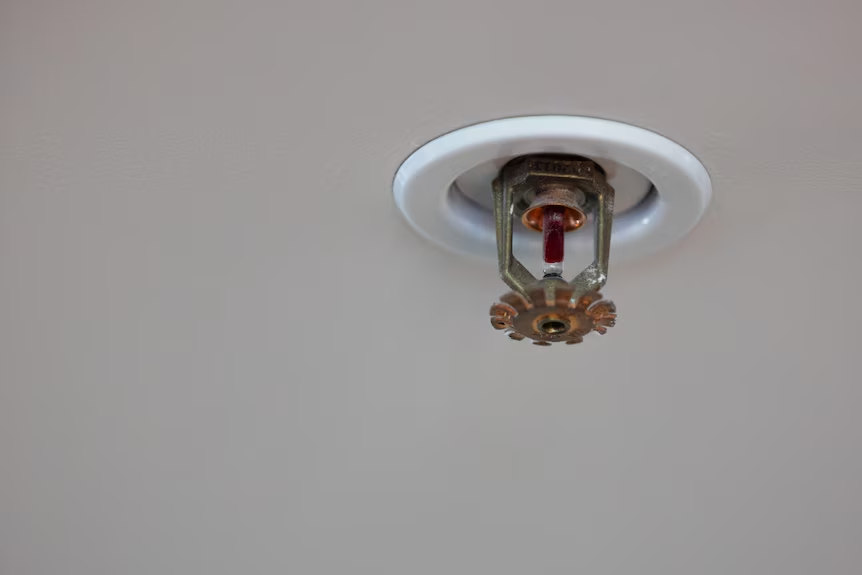
- Automatic fire sprinkler systems (where installed, common in larger or multi-storey SDA properties) — serviced to AS 1851 — monthly inspection and annual test.
- Fire doors and smoke/fire compartmentation — serviced to AS 1851 — typically 6-monthly inspection to confirm doors close and seal correctly
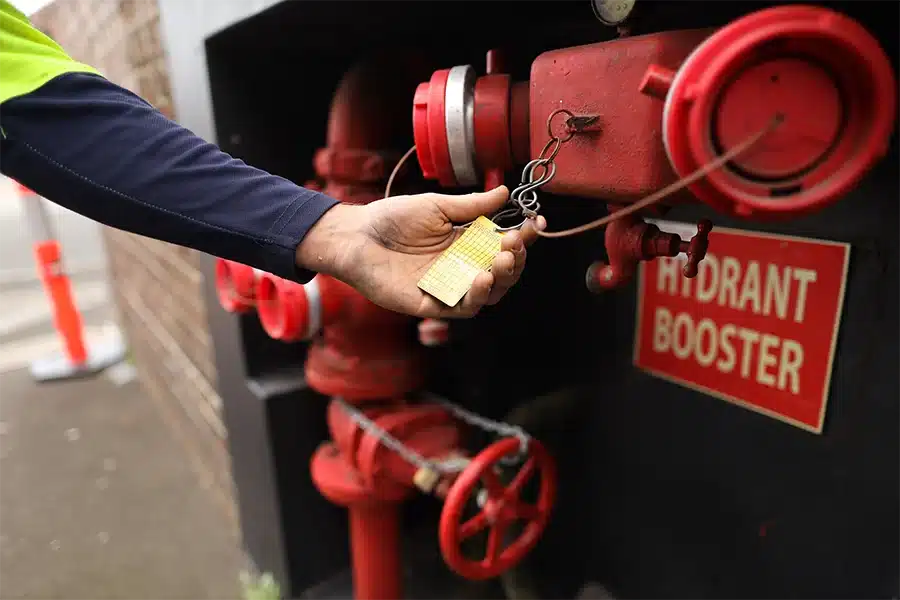
On top of the servicing itself, Victorian building owners must complete an Annual Essential Safety Measures Report (AESMR) confirming every ESM on the schedule has been inspected, tested and maintained as required — and keep records available for inspection within 24 hours if requested by a municipal building surveyor or fire authority. This obligation sits with the building owner regardless of whether the day-to-day servicing is contracted out, and it now falls under Victoria’s Building and Plumbing Commission (BPC), which took over building regulation from the VBA in 2025.
The NDIS layer on top of building law
Registered providers are expected to demonstrate that fire and emergency systems are compliant, tested and documented, with the evidence (test certificates, maintenance schedules, service records) available for audit.
In short, an NDIS housing provider carries two sets of fire safety obligations: the building owner’s duty under Victorian building law to maintain ESMs and lodge the AESMR, and the provider’s duty under the NDIS Practice Standards to show that fire and emergency arrangements genuinely work for the people living there.
Getting it right
A documented ESM schedule, a compliant AS 1851 servicing program, and an up-to-date AESMR are a critical components to meeting compliance obligations and ensuring life safety systems actually perform during an emergency.
If you manage NDIS housing and want a clear picture of what’s actually on your ESM schedule — and whether it’s being serviced to the standard your properties require — Compliance Services Australia can review your current arrangements and ensure you are meeting your service requirements. Get in touch with our team to arrange an assessment.
This article reflects Victorian building regulation and NDIS requirements as at August 2026 and is general information only, not legal advice. Requirements vary by state and by individual property — always confirm your specific ESM schedule and classification with a qualified building surveyor.
Need a compliance health check?
Contact Compliance Services to obtain a no-obligation free quote to cover all of your annual Essential Safety Measures services and inspections, and achieve peace of mind knowing your asset is protected.